
Every editor has a pile of press releases they never finish reading. Most of them don’t get rejected for being badly written. They get dropped because, about two lines in, the reader realises they’re being sold something.
A press release and an advertisement can look surprisingly alike, and the difference is rarely the topic. It’s the tone, the order of information, and the small habits we fall into when we’re excited about our own news. At WebPR, a PR agency working with Web3, crypto, AI and blockchain projects, we see the same slip-ups land on our desk again and again. Here are ten of the most common, and how to avoid them.
1. A headline that shouts
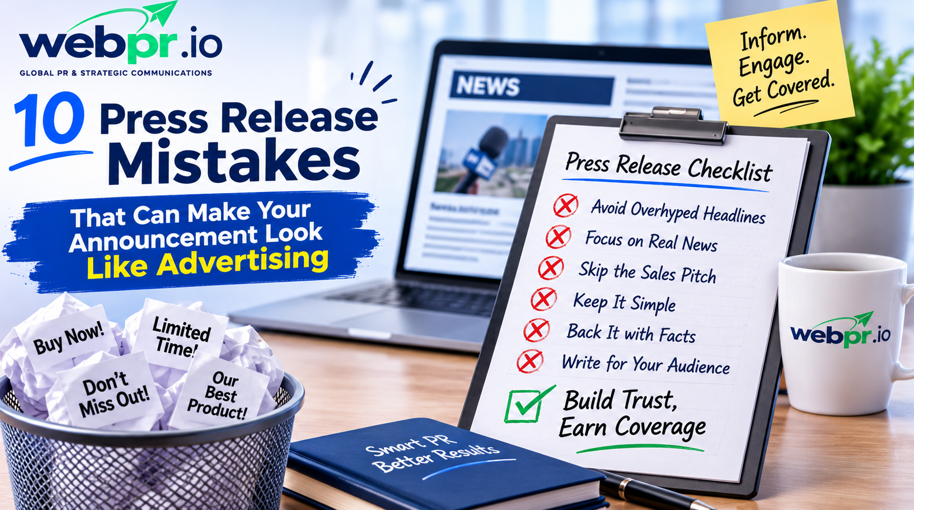
“Revolutionary New App Set to Transform the Way You Live!” That’s not a headline, it’s a billboard. Journalists and readers can smell exaggeration from a mile away. A good press release headline states what happened, plainly: “Layer 2 network launches grant program for early-stage builders.” Facts first. Excitement can live in the story, not the title.
2. Burying the actual news
If the first paragraph is about how passionate your company is, you’ve already lost the reader. Tell people what happened, who it affects, and why it matters within the first two or three sentences. Your company’s origin story can wait.
3. Piling on adjectives
“Innovative,” “cutting-edge,” “world-class,” “best-in-class.” These words feel impressive to the person writing them and mean almost nothing to the person reading them. Swap the adjective for a detail. Instead of “a game-changing wallet,” say “a wallet that cuts onboarding from ten steps to three.”
4. Talking like a sales pitch
“Don’t miss out!” “Limited-time offer!” “Call now!” If your release has a discount code in it, it’s an ad. A release informs; it doesn’t push. If there’s a genuine offer tied to the news, mention it once, calmly, near the end.
5. Announcing something that isn’t really news
This one hurts, but it’s true. A new logo, a slightly updated website, or “we’re proud to be a trusted partner” often isn’t news to anyone outside your office. Before you write, ask: would a stranger care about this? If the honest answer is no, find the angle that makes them care, or hold the release for a better moment.
6. Hiding behind jargon
“Leveraging synergies to deliver scalable, end-to-end solutions.” Nobody talks like this out loud, and nobody understands it on the page either. If you wouldn’t say a sentence to a friend over tea, don’t put it in a press release. Plain, people-first writing is also what Google’s own guidance on helpful content asks for, so it helps your release get found, too.
7. Quotes that sound like slogans
The CEO quote is where most releases quietly turn into ads. “We are thrilled to offer our customers an unparalleled experience.” Real people don’t talk like that. A good quote adds something the facts can’t: a reason, an opinion, a bit of honest feeling. “We kept hearing that small shops couldn’t afford delivery tracking, so we built something they could.” That sounds like a person.
8. Big claims with no proof
“The number one provider in the country.” According to whom? Any claim that praises your own company needs a number, a source, or a third party behind it. If you can’t back it up, cut it. Unproven bragging is the fastest way to lose a journalist’s trust.
9. Writing for yourselves, not for the reader
The release is full of internal language, product names nobody outside the team knows, and details only your colleagues care about. Try reading it as someone who has never heard of your company. Do they know what you do by the second paragraph? Do they know why they should care?
10. Forgetting the practical stuff
An ad wants you to feel something. A release wants you to be able to do something with it. Dates, locations, figures, names, a clear contact person, and a link for more information are what turn an announcement into a usable story. Skip them, and even a good release feels like a brochure. Once yours is tight, press release distribution is what puts it in front of the right outlets.
The simple test
Before you send anything out, read it once and ask yourself: if I took the company name off, would this still be interesting? If yes, you’ve written news. If not, you’ve probably written an ad.
Press releases work best when they sound like a thoughtful person telling you something worth knowing. Keep it honest, specific and a little bit human, and your announcement stands a much better chance of being read, and of being covered. For another take on how editors see these slip-ups, Creative Boom has a handy rundown of common press release mistakes.
Want a second pair of eyes?
If you’d like someone to look over your next announcement before it goes out, the team at WebPR is happy to help,find us on LinkedIn and X, or browse more on our blog.
And if you’re curious how good coverage also builds links and authority for your brand, we dig into that in How Online PR Builds Backlinks and Brand Authority Through Media Publishing.
For a broader primer on the SEO side of coverage, Search Engine Land’s guide to digital PR for SEO is worth a read.